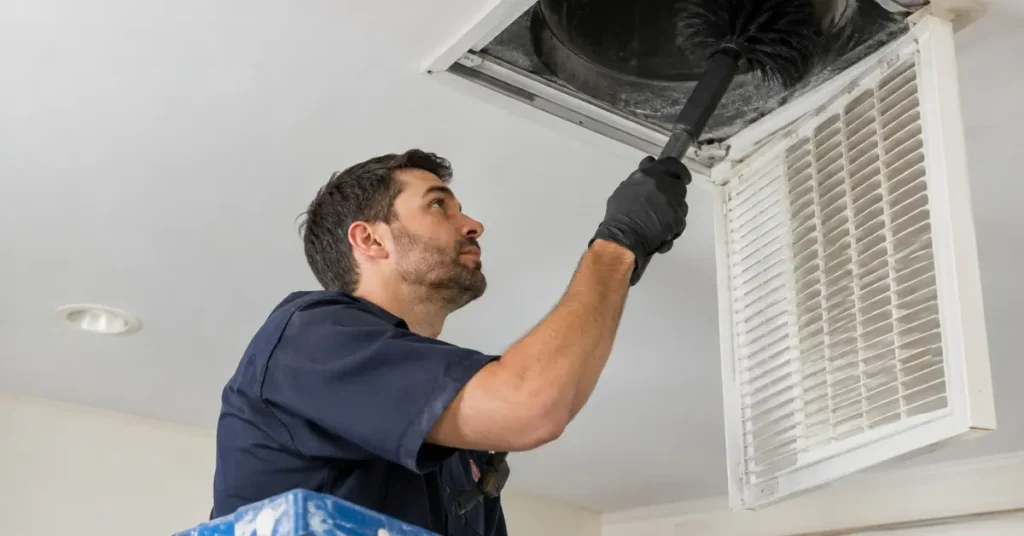
Mold can become a concern inside an HVAC system when moisture, condensation, and organic debris create conditions where growth can develop. Because the HVAC system moves air throughout a property, contaminated components may contribute to the movement of mold spores and other biological particles.
For a useful explanation of how duct cleaning addresses dust, mold, and allergens, see this guide on how duct cleaning works to remove dust, mold, and allergens. Professional mold treatment for air ducts can then be considered when visible or suspected microbial growth is connected to the duct system.
EPA guidance notes that moisture is a major factor behind biological growth in HVAC systems and that substantial visible mold contamination can be a reason to consider professional duct cleaning.
Why Can Mold Inside HVAC Systems Affect Indoor Air?
An HVAC system continuously moves air through supply and return pathways. If mold is growing on contaminated components, airflow may help distribute spores or other particles into occupied areas.
This does not mean every dusty duct contains harmful mold. EPA specifically notes that ordinary light dust in air ducts does not automatically present a health risk. The concern becomes more significant when substantial mold growth, moisture, or other contamination is present.
Potential signs that deserve closer attention include:
- Persistent musty odors when the HVAC system operates
- Visible growth around accessible HVAC components
- Recurring moisture or condensation near ducts
- Water damage around the air handling system
- Unexplained buildup around supply or return areas
- Mold that repeatedly returns after surface cleaning
CDC guidance also explains that damp or moldy environments can be associated with respiratory symptoms, allergic reactions, and irritation in some people.
How Does Mold Treatment for Air Ducts Reduce Airborne Contaminants?
Mold treatment for air ducts can help reduce airborne contaminants by addressing microbial growth on appropriate HVAC surfaces after the underlying contamination and moisture source have been evaluated. Removing contamination can reduce the amount of material available to become disturbed by airflow, while moisture control helps limit recurring growth.
The process is not simply about spraying a product into the ductwork. Effective HVAC mold remediation should begin with identifying where contamination exists and why moisture is present.
EPA states that correcting the condition that caused mold is essential because mold can return when the underlying moisture problem remains unresolved.
A professional approach may include:
- System assessment: Examine accessible ductwork and HVAC components for visible contamination and moisture concerns.
- Source identification: Look for condensation, leaks, drainage problems, or other conditions supporting microbial growth.
- Cleaning: Remove dust, debris, and loose contamination where appropriate.
- Targeted treatment: Apply an appropriate treatment to suitable surfaces according to product directions.
- Final inspection: Check the treated areas and address conditions that could encourage future growth.
MDF describes its duct treatment process as assessment, application, protection, and final peace of mind, with treatment intended to address mold, bacteria, and odor concerns.
What Should Happen Before Mold Removal From an HVAC System?
Mold treatment should not be viewed as a substitute for fixing water or humidity problems. If condensation continues around a cooling coil, duct, drain pan, or poorly insulated area, new growth may develop after treatment.
EPA identifies moisture control as the most effective way to prevent biological growth in air ducts. Recommended measures include correcting leaks, addressing standing water, maintaining condensate drainage, and properly sealing and insulating ductwork.
For Skokie properties, this is especially important when an HVAC concern involves an attic, crawl space, basement, poorly insulated duct, or area with recurring condensation.
Homeowners should also understand that not every duct material can be treated in the same way. EPA explains that wet or moldy fiberglass duct material generally cannot be effectively cleaned and may need to be removed and replaced.
Which HVAC Areas May Need Attention During Mold Remediation?
Mold contamination is not necessarily limited to the visible portion of a supply duct. Depending on the HVAC design, several components may require inspection.
Ductwork and Supply Pathways
Supply ducts transport conditioned air into rooms. If substantial contamination is present inside accessible hard-surface ductwork, cleaning and appropriate treatment may help remove the source of airborne particles.
Air Handler and Cooling Components
Cooling coils and condensate areas deserve attention because condensation can create moisture conditions that support biological growth. EPA identifies cooling coils and drain pans as important areas for moisture control.
Return Air Areas
Return pathways pull air back toward the HVAC equipment. Dust and debris can accumulate around return grilles and connected components, making inspection and cleaning useful when contamination is suspected.
Filters and Accessible Components
A suitable filter can help capture airborne particles, but it does not replace cleaning contaminated HVAC components or correcting moisture problems.
When Is Professional Mold Treatment in HVAC Systems Worth Considering?
A professional assessment makes sense when there is evidence of substantial mold growth, recurring musty odors combined with moisture concerns, or visible contamination associated with HVAC components.
It is also important to avoid assuming that every dark spot is mold. EPA recommends asking a service provider to show suspected contamination and notes that definitive identification may require expert evaluation or laboratory analysis.
If inspection indicates that duct treatment is the appropriate next step, professional duct treatment in Skokie can address the affected system with a targeted process.
MDF Air Duct Cleaning provides duct treatment services in Skokie and nearby communities, including Evanston, Winnetka, Lincolnwood, and Morton Grove. Its published service information describes treatment intended to address odors, bacteria, and microbial growth.
For local service planning, the business lists hours of 7:00 AM to 9:00 PM, Monday through Sunday on its website. The provided business location is 8340 Kostner Ave, Skokie, IL 60076. For a service inquiry, call 2244637739.
How Can You Help Prevent Mold From Returning?
Treatment becomes more useful when combined with steps that keep the HVAC system dry and properly maintained. Mold requires moisture to grow, so prevention should focus on the conditions that allow moisture to remain inside the system.
Helpful measures include:
- Keep indoor humidity at an appropriate level.
- Address plumbing or HVAC leaks promptly.
- Check condensate drain pans and drainage.
- Maintain HVAC filters according to system requirements.
- Have suspected moisture problems evaluated.
- Keep ductwork properly sealed and insulated where needed.
- Avoid ignoring recurring musty odors.
EPA recommends indoor humidity generally be maintained around 30% to 50% when possible, while CDC also recommends keeping home humidity no higher than 50% to help prevent mold growth.
These measures do not guarantee that mold will never develop, but they reduce conditions that support recurring growth.
What Benefits Can Proper Air Duct Mold Removal Provide?
When an HVAC system has confirmed contamination, properly performed air duct mold removal can address a potential source of airborne biological particles. Cleaning and treatment can also help with musty odors when those odors originate from contaminated HVAC components.
The goal should be a cleaner, properly maintained HVAC system rather than simply masking an odor. A successful approach considers the source of moisture, the affected components, the type of duct material, and the condition of the overall system.
It is also important to keep expectations realistic. EPA says there is limited evidence for broad benefits from routine duct cleaning and does not recommend cleaning solely on a routine schedule. The strongest reason to investigate duct contamination is an identifiable problem such as substantial mold growth, excessive debris, or particles being released from registers.
If you are dealing with suspected HVAC contamination in Skokie, professional evaluation can help determine whether cleaning, treatment, moisture correction, or another solution is appropriate.
For local information about services and coverage, visit MDF Air Duct Cleaning.
Frequently Asked Questions
How Much Does Mold Treatment for Air Ducts Cost?
The cost varies because every HVAC system and contamination problem is different. Factors can include system size, the number of affected components, accessibility, duct material, the level of contamination, and whether cleaning or moisture correction is also required. A professional inspection is the best way to determine the appropriate scope before discussing the final cost.
How Long Does HVAC Mold Remediation Take?
Turnaround depends on the size and condition of the HVAC system, how accessible the affected areas are, and whether additional cleaning or moisture correction is needed. A straightforward treatment may require less time than a larger contaminated system. The service provider should explain the expected process after assessing the property.
Does MDF Air Duct Cleaning Serve Areas Outside Skokie?
Yes. MDF Air Duct Cleaning lists Skokie and surrounding North Chicago suburbs among its service areas. Published locations include communities such as Evanston, Glenview, Winnetka, Lincolnwood, Morton Grove, Northbrook, and Highland Park. Coverage can vary by service, so confirm availability when requesting an appointment.
What Is Included in Mold Treatment for HVAC Systems?
The scope depends on the condition of the system. A proper process may include an assessment, identification of affected areas, cleaning of appropriate surfaces, targeted treatment, and a final inspection. MDF describes its duct treatment process around assessment, application, protection, and addressing odor and microbial concerns.
Can I Request Urgent HVAC Mold Treatment?
You can contact a professional when you have an urgent concern such as visible contamination, a strong recurring musty odor, or suspected water intrusion affecting the HVAC system. However, emergency response or same-day availability should not be assumed unless the provider confirms it. If significant water damage is involved, addressing the moisture source should be a priority.
Does Mold Treatment Permanently Prevent Mold?
No treatment should be presented as a permanent guarantee. Mold can return if the underlying moisture problem remains. EPA emphasizes that correcting water or moisture conditions is essential to preventing recurring growth. Proper treatment should therefore be combined with moisture control, HVAC maintenance, and correction of leaks or condensation problems.
Why Choose MDF Air Duct Cleaning for Duct Treatment?
MDF Air Duct Cleaning offers duct treatment along with air duct and HVAC cleaning services for residential and commercial properties. Its published process includes assessment, treatment application, and protective measures intended to address microbial growth and odors. The company also lists Skokie and surrounding communities within its service area.